
.png?width=48&height=48&name=KVP-background1%20(2).png)

Key takeaways
-
Market cycles are unavoidable, but long-term success comes from focusing on what you can control, including discipline, preparation, and decision-making under pressure.
-
Strategies like avoiding panic selling, maintaining a cash reserve, diversifying broadly, and investing consistently help reduce emotional mistakes during volatile periods.
-
Patience and structure matter more than prediction, as investors who stay invested and follow a clear plan are best positioned to benefit from recovery and compounding over time.
Market cycles are a natural part of the world. Stocks go up and investor confidence rises with it. And when stocks go down, that same confidence depletes.
Ultimately, there’s very little you can do to control what happens with the world. It’s a mass force without reason — and is nearly impossible to predict (just ask Jim Cramer).
The worst thing you can do, as an investor, is allow emotion to take hold. Afterall, you can’t dictate what happens next. But what you can do is define and take power over the things you can control.
As an investor, understanding this basic principle is the foundation of prudent investing. It allows you to disassociate yourself from emotion and think proactively. And in turn, benefit regardless of where the markets are heading.
Rule #1: Avoid Panic Selling
“The real key to making money in stocks is not to get scared out of them.” - Peter Lynch
We all know the adage Buy Low, Sell High. Panic selling is quite the opposite of these words of wisdom. Now, there are times when selling does make sense – like purchasing thousands of shares in a penny stock. But most of the time, especially when holding companies like Amazon, Apple, and other blue chip companies, the best move is to stay put.
The best way to avoid panic selling is to invest in companies you believe in. Do you believe Amazon will be around and flourishing ten years from now? Odds are, likely. Do you believe in a company named Aliens R’ Us that concentrates in selling products built for E.T.? Not so much.
Having confidence in what you invest in — regardless of what the stock is doing – allows you to better avoid emotional decisions and think practical.
Rule #2: Build You War Chest
"Cash isn't fear. Cash is ammunition." - Warren Buffett
When the market crashes, holding a sizable cash reserve serves many needs. First, you’ll have a buffer for covering living expenses your investment could’ve covered. And second, it gives you the ammunition you need to buy stocks that are undervalued.
Think about the money you could’ve made if you invested post-dot-com crash. For example, the top stocks then were: Cisco, Intel, Dell, and Microsoft (coined “The Four Horsemen). Assuming you spread your investments equally across all companies equally, you’d be up $44,825.
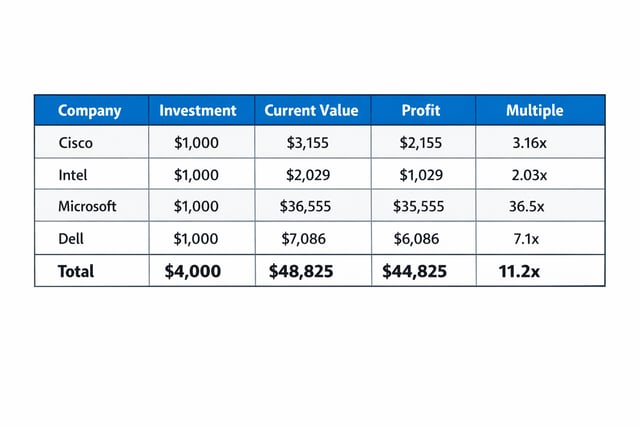
*Investment date: December 31, 2000
The best way to preserve your cash reserve in times of trouble is to invest in these investment vehicles:
High-yield savings accounts — extremely liquid; lets your cash earn while staying instantly accessible and currently returning 4-5% APY.
Money market funds — low-volatility and stable; historically resilient during downturns and a step up in yield.
Short-term CDs — predictable returns with minimal risk; stagger them so you always have something maturing.
Treasury bills — government-backed safety with strong liquidity; ideal for holding cash without letting it idle.
Rule #3: Embrace Diversification as a Necessity
“The only investors who shouldn’t diversify are those who are right 100% of the time.” - John Templeton
Looking at the chart, Microsoft was the big winner, while other stocks — most notably, Intel — suffered for years until breaking even. While these four together did break the NASDAQ and S&P 500 multiple returns of 8.54X and 5.4X, respectively, during this time, only one of these stocks beat both outright.
Diversification is not optional — it’s a necessity. It limits loss when times are bad, and propels gains assuming you don’t put all your eggs in one basket and get lucky.
Attempting to take millions and trying to turn it into billions is not the name of the game. Instead, it’s about growing your wealth with confidence.
Rule #4: Use Dollar-Cost Averaging to Stay Consistent
“Investing should be more like watching paint dry or grass grow. If you want excitement, take $800 and go to Las Vegas.” – Paul Samuelson
Dollar-cost averaging (DCA) is one of the easiest ways to stay invested without getting caught up in daily market noise. Instead of trying to guess where the market is heading — a losing battle no matter how confident you feel — you invest a fixed amount on a set schedule. Whether stocks are surging, sinking, or simply drifting sideways, your plan stays the same.
This structure works in your favor. When prices fall, your regular contribution buys more shares. When prices rise, you already own the shares you accumulated at lower levels. Volatility becomes less of a threat and more of a tool — something you use, not something you fear.
Now compare this to someone trying to time the market. They sit on the sidelines during a downturn, waiting for the “perfect” moment to jump in. Then the market suddenly rallies 8% in a week. They hesitate. It runs another 5%. They hesitate again. By the time they muster the confidence to buy, they’re paying a premium — all because emotion, not strategy, dictated the decision. The DCA investor, meanwhile, quietly accumulated shares at lower prices and never had to guess.
The real strength of DCA isn’t its math, but its psychology. It removes hesitation, doubt, and second-guessing. It protects you from acting on impulse. When the market tests your patience, you’re anchored by a rule that doesn’t change with your mood. You keep moving forward, and over time, that consistency becomes your biggest advantage.
Dollar-Cost Averaging vs. Market Timing: A Practical Comparison
Scenario: Both investors plan to put $6,000 into the market over six months. The market is volatile (drops early, recovers sharply).
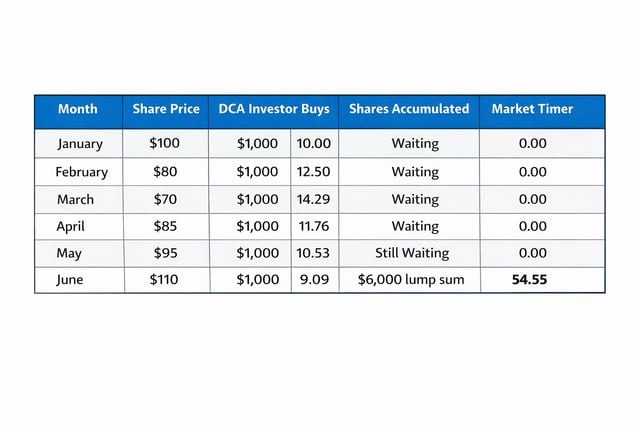
Total Shares Owned
- DCA Investor: 68.17 shares
- Market Timer: 54.55 shares
Value at June Price ($110/share)
- DCA Investor: 68.17 × $110 = $7,498.70
- Market Timer: 54.55 × $110 = $6,000.50
Difference:
DCA is ahead by $1,498.20 — simply by showing up every month.
Rule #5: Keep Calm and Carry On
“Patience is bitter, but its fruit is sweet.” – Aristotle
When markets turn chaotic, most investors don’t lose money because of the decline itself — they lose money because of how they respond to it. Fear, urgency, and the instinct to “do something” can be far more damaging than any temporary drop in the S&P 500. Keeping calm isn’t passive. It’s a strategy. It’s the decision to avoid turning a temporary setback into a permanent loss.
Take any major downturn over the last 50 years. The pattern repeats. Markets fall sharply, headlines get louder, and investors rush for the exits. But what happens next is almost always the same: markets stabilize, recover, and move forward while those who sold are left watching from the sidelines. The investors who endured — who carried on — didn’t need to predict anything. They simply refused to let panic rewrite their plan.
Keeping calm doesn’t mean ignoring risk. It means understanding it. It means acknowledging volatility as a feature of investing, not a failure of it. When you carry on through uncertainty, you give your portfolio the chance to do what it’s built to do: compound. And over a lifetime of investing, that simple act of patience becomes a superpower.
Five Additional Rules to Keep in Mind
Stay Invested
Over a long enough timeline, the market rewards participation, not perfection. Missing even a few of the strongest recovery days can erase years of returns. Staying invested ensures you’re present when the market turns — because it always does.
Revisit Your Thesis, Not Your Feelings
When a stock falls, the real question isn’t whether you’re uncomfortable — it’s whether the business itself has changed. If the answer is no, the decline is noise, not signal. Let fundamentals, not mood, guide your decisions.
Match Your Portfolio to Your Timeline
Short-term money needs stability; long-term money needs growth. Mixing the two is where most preventable stress comes from. Aligning your portfolio with your actual time horizon keeps you grounded when volatility hits.
Limit Your Noise Intake
The more headlines you consume, the more reactive you become. Markets don’t punish patience — they punish emotion. Protect your attention and your decision-making improves instantly.
Seek Professional Guidance When the Stakes Get High
A skilled financial professional doesn’t claim to predict the market — they help you avoid the mistakes that derail most investors. They pressure-test your thinking, provide clarity during uncertainty, and create structure around your goals. When errors become costly, another steady mind is an advantage.
Keep Your Head While Others Lose Theirs
Market cycles will rise and fall. Sentiment will swing from euphoric to panicked and back again. None of that is within your control — and none of it needs to be. Your edge isn’t forecasting the next move; it’s building a plan sturdy enough to withstand whatever comes.
Stay patient. Stay prepared. Stay level-headed when others aren’t. Over time, that calm consistency becomes the most powerful return you’ll ever earn.