
.png?width=48&height=48&name=KVP-background1%20(2).png)

Key takeaways
- U.S. money-market fund assets hit an all-time high of $7.37 trillion in October 2025, reflecting widespread investor caution and a shift toward liquidity amid market uncertainty.
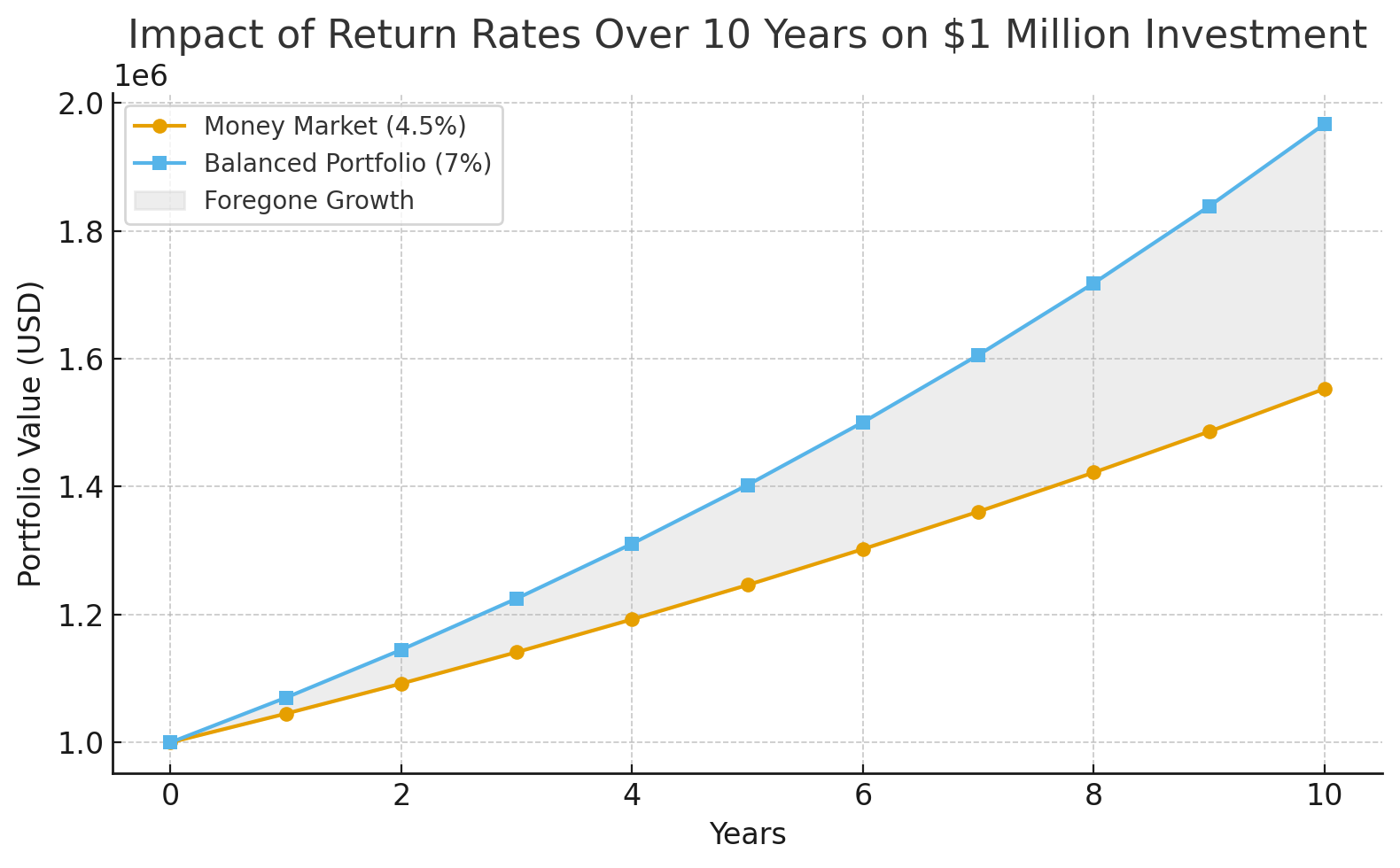
- A $1 million investment earning 4.5% annually grows to about $1.55 million in 10 years — but a balanced portfolio at 7% would reach $1.97 million, meaning over $400,000 in lost opportunity by playing it safe.
- Elevated yields make cash attractive, but overexposure risks long-term erosion from inflation and reinvestment risk. Advisors recommend using structured cash “buckets” for liquidity, mid-term needs, and growth capital.
As of October 15, 2025, U.S. money-market fund assets stood at $7.37 trillion. That’s an all-time record — and a vivid picture of today’s investor psychology. After years of market swings, inflation scares, and geopolitical shocks, many households and institutions are opting for safety and liquidity over long-term growth.
The appeal is understandable. Cash-equivalent vehicles are once again offering income. Short-term Treasury bills and money market funds now yield in the low-to-mid 4 % range, making “waiting it out” sound responsible. But this record-setting stash of idle cash also tells another story — one of caution, timing, and opportunity cost.
The Rise of Cash Hoarding
Over recent years, money market assets have risen dramatically. Total U.S. money-market fund assets increased from approximately $6.85 trillion at end-2024 to about $7.37 trillion by mid-October 2025. A key moment: on March 5, 2025, ICI reported assets reached $7.03 trillion — a previous record.
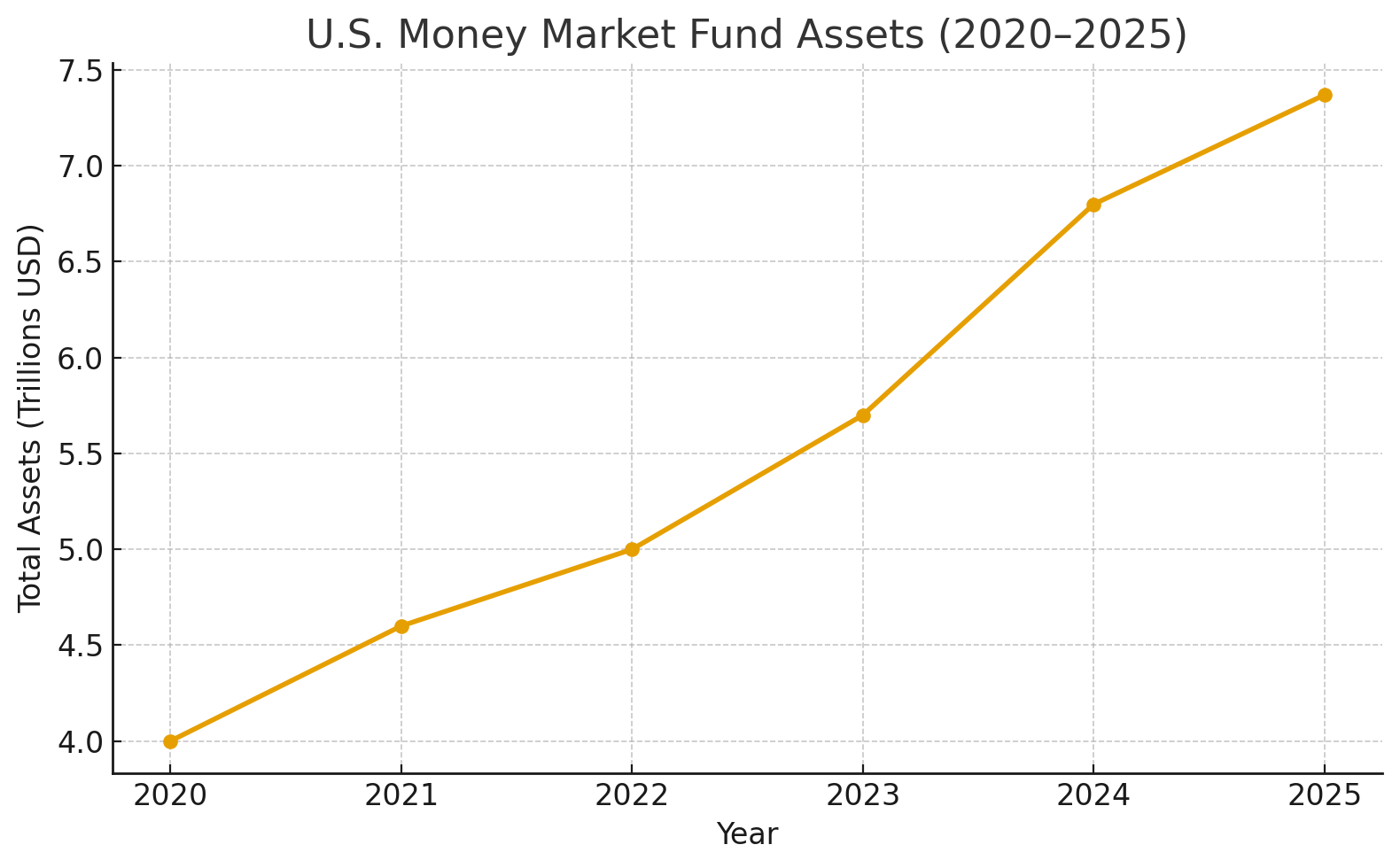
Source: Investment Company Institute (ICI)
This surge reflects two major forces at work:
- Attractive short-term yields: With the Federal Reserve’s policy rate elevated, money market funds and Treasury bills are offering near-historic yield levels.
- Heightened risk and uncertainty: Volatility in both equity and bond markets, inflation concerns, and global economic uncertainty have prompted both retail and institutional investors to favor liquidity and flexibility.
That combination creates the perfect environment for large cash accumulation. But the question remains: is large cash always a defensive move — or could it be a missed opportunity?
The Trade-Offs of Playing It Safe
Holding cash isn’t inherently wrong — it provides flexibility, liquidity, and peace of mind. But it’s important to understand the trade-offs.
Suppose you held $1 million entirely in money market funds yielding roughly 4.5 % annually. After 10 years (ignoring taxes and assuming stable yield), you’d have about $1.55 million. That sounds good until you compare it with a balanced portfolio earning, say, 7 % annually, which would grow to near $1.97 million. That’s ~$420,000 in foregone growth.
Inflation adds another subtle cost. If inflation is 2–3 % and your nominal return is 4.5 %, your real return is only about 1.5–2.5 %. Over a decade, that difference accumulates. Furthermore, if interest rates decline (which historical patterns suggest once the Fed begins cutting), your reinvestment yield may fall — reducing future return potential even further.
Behavioral Finance and the “Fear Premium”
The bigger challenge isn’t just math; it’s emotion. Behavioral finance calls this the “fear premium” — the hidden cost investors pay to feel safe. If caution becomes the primary driver of asset allocation, the result can be under-performance. And as you could assume, missing market rebounds erodes returns meaningfully.
The Path Forward
Cash is a tool — not a strategy. It’s vital for emergencies, stability, and optionality. But if it becomes the cornerstone of your portfolio, you may risk missing the very growth that long-term wealth demands.
As yields eventually normalize, the difference between earning 4 % and 7 % will matter again — not in the next quarter, but across decades of compounding. Now is the moment for investors to ask: Does my current cash allocation reflect my strategy — or my hesitation?