
.png?width=48&height=48&name=KVP-background1%20(2).png)

Markets are loud.
Every day brings another prediction about interest rates, inflation, artificial intelligence, elections, recessions, stock valuations, or the next great investment opportunity. Some of those developments matter. Many will eventually be forgotten.
Long-term investing requires knowing the difference.
The principles behind building wealth over time are remarkably durable. Investors need to understand the relationship between risk and reward, own a portfolio suited to what they are actually trying to accomplish, remain diversified, maintain sufficient liquidity, and give their investments enough time to work.
The goal is not to create a portfolio that never falls. Such a portfolio does not exist.
The goal is to build one capable of surviving difficult markets without forcing you to abandon the strategy that was designed to get you where you want to go.
Understanding Risk and Reward in Long-Term Investing
Every investment decision involves a tradeoff.
Assets with greater potential for long-term appreciation generally come with greater uncertainty along the way. Assets designed primarily for stability may reduce short-term fluctuations but can offer less opportunity for long-term growth.
That makes risk more complicated than simply asking, “How much can I tolerate losing?”
Investors should consider at least three different questions:
How much risk am I comfortable taking? This is your psychological risk tolerance.
How much risk can I financially afford to take? Someone who will need substantial portfolio withdrawals within several years may have less capacity for volatility than someone investing money they will not need for decades.
How much risk might I need to take to pursue my goals? Avoiding nearly all investment risk may feel safe, but it can introduce a different risk if your assets fail to grow enough to support future spending or keep pace with rising costs.
The right portfolio attempts to balance all three.
That is why effective investing rarely begins with choosing a stock, fund, or market sector. It begins with understanding what the money is supposed to accomplish.
Start With Asset Allocation, Not Individual Investments
Asset allocation determines how a portfolio is divided among investments such as stocks, bonds, cash, and other asset classes.
Those different assets perform different jobs.
Stocks may provide greater long-term growth potential but can experience substantial price swings. Bonds can provide income and help moderate portfolio volatility, although they carry risks of their own. Cash provides liquidity and stability but may sacrifice growth when held in excess for long periods.
There is no universally correct combination.
An investor saving for retirement 25 years from now may reasonably hold a very different portfolio from someone relying on investment assets to fund living expenses next year.
This is why strategic asset allocation should begin with your goals rather than with a prediction about which portion of the market will perform best next.
A portfolio should be constructed around the investor. The investor should not have to reshape their life around the portfolio.
Diversification Helps a Portfolio Endure
Asset allocation answers one question: How should capital be divided among broad investment categories?
Diversification goes deeper.
Within those categories, investors can spread exposure across companies, industries, investment styles, geographic regions, and other sources of return. The idea is simple. Your financial future should not depend too heavily on one company, one sector, one asset class, or one economic outcome.
Diversification does not guarantee gains or prevent losses. It can, however, reduce the damage that any single investment mistake or market disruption can inflict on an overall portfolio.
Geography matters as well.
U.S. companies represent an enormous part of global markets, but they do not represent the entire global economy. Different countries contain different industries, demographic trends, economic cycles, currencies, and sources of growth. Thoughtful diversification beyond U.S. markets can broaden the opportunity set while reducing dependence on a single market.
The objective is not diversification for diversification’s sake. Owning dozens of investments that behave almost identically accomplishes little.
Good diversification means owning investments with distinct roles inside a coordinated portfolio.

Investment Selection Still Matters
Asset allocation may establish the structure of a portfolio, but investors still have to decide how each piece will be implemented.
For many investors, exchange-traded funds have become one tool for gaining diversified exposure to markets, sectors, investment styles, and geographic regions. Yet two ETFs with similar names can have very different holdings, weighting methodologies, costs, liquidity characteristics, and risk profiles.
That means fund selection should go beyond recent returns.
Investors should understand what an ETF actually owns, how concentrated its largest positions are, what benchmark or strategy it follows, what it costs, and what purpose it serves in the broader portfolio. Our guide to choosing exchange-traded funds outlines several factors worth reviewing before investing.
Every investment should have a job.
If you cannot explain why something is in the portfolio, it may be worth asking whether it belongs there.
Cash Has a Role, Too
Long-term investing does not mean every available dollar needs to be invested aggressively.
Cash can provide an emergency reserve, fund upcoming expenses, cover portfolio withdrawals, and give investors flexibility during uncertain periods.
The problem begins when temporary caution quietly becomes a permanent investment strategy.
Investors sometimes move substantial assets into cash after markets decline and wait for conditions to “feel better” before investing again. That creates a difficult second decision: when do you get back in?
Markets rarely announce that the danger has passed.
Holding an appropriate cash reserve can strengthen a long-term plan. Holding far more cash than your goals require may create opportunity costs, especially over long periods when those assets could otherwise be participating in investment growth.
The distinction is important. Cash is a financial tool, not necessarily a complete long-term investment strategy.
Volatility Is Not the Same Thing as Failure
An enduring portfolio is not one that avoids every decline.
It is one designed so that a decline does not destroy the financial plan.
Market volatility can feel like evidence that something has gone wrong. Often, however, fluctuating prices are simply part of owning assets whose future returns are uncertain.
That does not make every decline harmless. Some businesses fail. Some investments never recover. Economic conditions can deteriorate. Valuations can become excessive.
But investors should distinguish those risks from ordinary market fluctuation.
Understanding how market volatility differs from permanent investment loss can make it easier to evaluate whether a portfolio actually requires a change or whether the investor is simply experiencing the discomfort that comes with long-term ownership.
This is also where diversification, asset allocation, and liquidity work together.
If money needed for near-term expenses is held appropriately, investors may be less likely to sell long-term holdings simply because markets are temporarily down.
Your Behavior Is Part of Your Portfolio
Portfolio construction gets much of the attention in investing. Investor behavior deserves just as much.
Fear can make investors sell after prices have already declined. Excitement can make them buy after prices have already risen. Recent events can feel disproportionately important. A successful investment can create the impression that good fortune was entirely the result of skill.
These tendencies are well documented in behavioral finance and the study of how emotions influence investment decisions.
They are also difficult to recognize in ourselves.
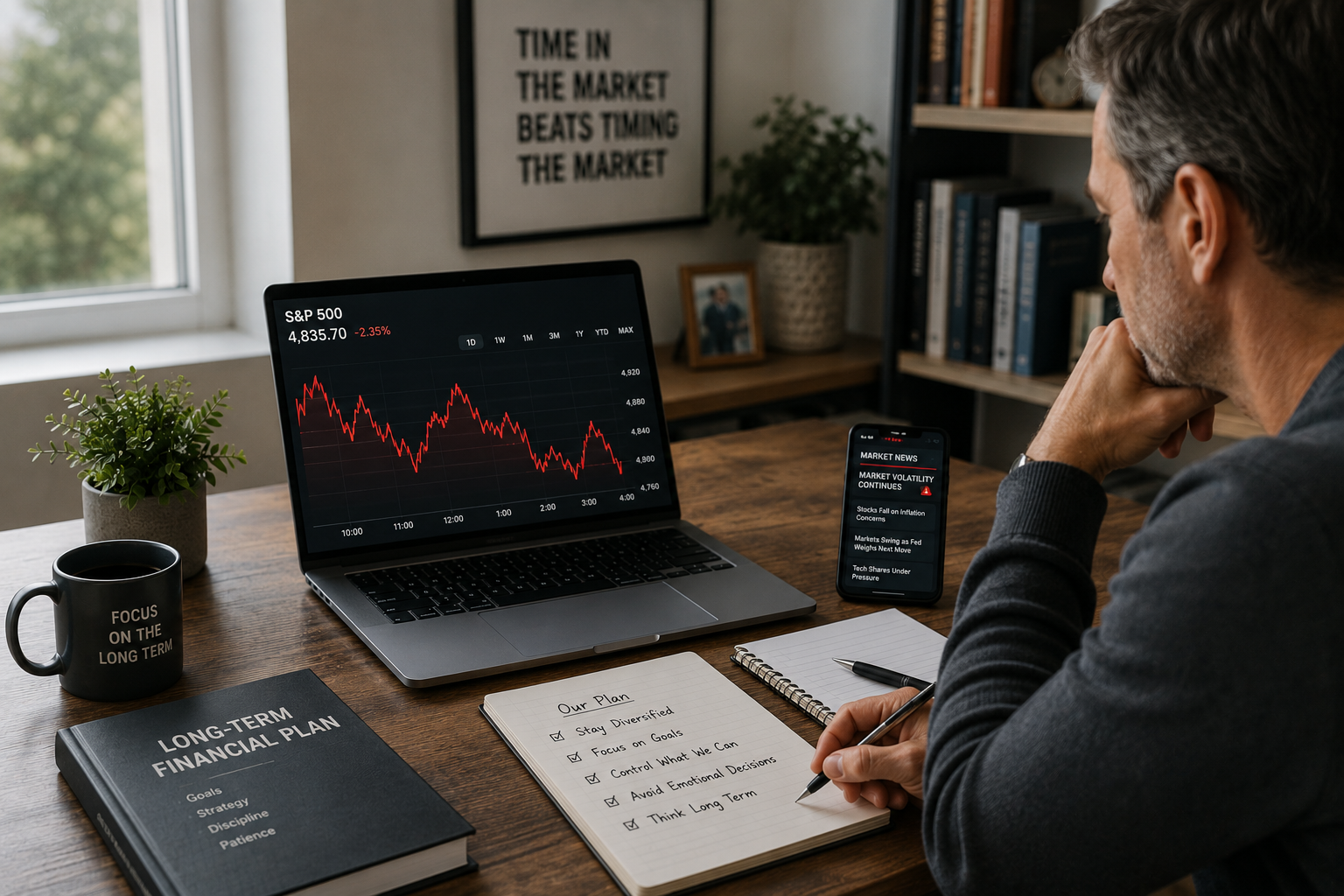
That is one reason a written investment strategy can be valuable. Decisions about target allocation, liquidity, diversification, rebalancing, and acceptable risk can be made when markets are relatively calm rather than improvised when fear or excitement is highest.
The emotional swings seen among retail investors during 2025 offer a useful example of how quickly sentiment can move from pessimism to optimism even as the underlying investment horizon remains measured in years or decades.
Successful long-term investing frequently requires doing less, not more.

Staying Invested Can Matter More Than Predicting the Next Move
Market timing sounds appealing in theory.
Sell before the decline. Wait. Buy again near the bottom.
Doing that successfully requires making two good decisions: knowing when to exit and knowing when to return.
That second decision is often underestimated.
Investors who sell during periods of fear may continue waiting after markets begin to recover because the economic environment still looks uncertain. By the time confidence returns, prices may have already moved significantly.
Rather than repeatedly trying to identify market tops and bottoms, long-term investors can build a strategy capable of functioning through both.
That does not mean ignoring changes in your portfolio or the economy. It means recognizing the difference between thoughtful portfolio management and reactive trading.
During particularly difficult markets, having a predefined process for staying the course through market volatility can help keep short-term conditions from overtaking long-term objectives.
And for investors whose confidence has already been shaken, there are practical ways to rebuild investment confidence after a significant market decline without trying to predict exactly when the next recovery will begin.
Time Allows Compounding to Do the Heavy Lifting
Long-term investing becomes especially powerful because returns can build upon previous returns.
Investment growth can generate additional growth. Reinvested dividends can purchase additional shares. New contributions add more capital capable of participating in future returns.
At first, the results may appear incremental. Over sufficiently long periods, that compounding can become increasingly meaningful.
This is why starting earlier can be so valuable and why repeatedly interrupting an investment strategy can carry costs that are not immediately obvious.
The greatest advantage an investor has may not be access to better predictions. It may simply be time.
Understanding how compounding rewards time in the market helps shift the focus from what an investment might do next month to what a disciplined strategy may accomplish over decades.
Rebalancing Keeps Risk From Quietly Changing
Even a well-designed portfolio will not remain perfectly aligned forever.
Suppose equities outperform bonds for an extended period. Without any deliberate action by the investor, stocks may gradually represent a larger portion of the portfolio.
The investor is now taking more equity risk than originally intended.
The reverse can happen following a significant decline.
Rebalancing periodically brings investments back toward their intended allocations. That can mean trimming positions that have become overweight and adding to areas that have become underweight.
The purpose is not to predict which asset will outperform next.
It is to maintain the level and type of risk the portfolio was designed to take.
Rebalancing should also account for taxes, transaction costs, new contributions, withdrawals, and changes to the investor’s financial situation.
Pay Attention to the Economy Without Building Your Life Around a Forecast
Inflation, interest rates, employment, corporate earnings, consumer spending, credit conditions, and geopolitical events can all influence investment markets.
They deserve attention.
They do not deserve control over every decision.
Economic data can help investors understand the environment in which their portfolios operate. The economic signals investors monitored heading into 2026, for example, show how inflation, employment, rates, consumer activity, and corporate conditions can interact.
But economic forecasting should not replace planning.
An investor with a 20-year horizon should be careful about rebuilding a portfolio around a six-month economic prediction. Forecasts change. Unexpected events happen. Markets themselves frequently move before the economic picture becomes obvious.
A durable portfolio assumes uncertainty rather than requiring perfect foresight.
Be Careful When One Investment Story Takes Over the Market
Every market cycle seems to produce a dominant narrative.
Sometimes the underlying opportunity is real.
That does not mean every investment connected to the story is attractive at every price.
Artificial intelligence provides a useful modern example. The technology may transform industries and create substantial economic value while individual AI-related companies still face questions about valuation, competition, profitability, and execution.
Our examination of AI, the stock market, and lessons from previous periods of technological enthusiasm highlights an important distinction for long-term investors: believing in a technology is not the same as believing every investment associated with that technology will succeed.
The same principle applies to any popular theme.
Investment narratives change much faster than financial goals.
Your Portfolio Should Change When Your Life Changes
Staying committed to a long-term strategy does not mean refusing to change it.
A portfolio built for a 40-year-old accumulating retirement assets should not necessarily look the same when that investor reaches retirement. Income needs change. Tax circumstances change. Health considerations, family responsibilities, estate priorities, and risk capacity change.
Some transitions can be especially significant.
The death of a spouse, for example, can change household income, liquidity needs, account ownership, taxes, estate considerations, and the amount of investment risk that remains appropriate. In those circumstances, major portfolio decisions may deserve additional time rather than an immediate reaction. Our guide to financial decisions during the first 90 days after losing a spouse explains which issues may require prompt attention and which decisions can often wait.
A long-term plan should be durable, not rigid.
Change the portfolio because the plan changed.
Do not change the plan simply because the market did.
What Does a Portfolio Built to Last Look Like?
There is no single model that works for everyone.
But durable portfolios tend to share several characteristics.
They have a purpose. The investor knows what the money is intended to accomplish.
They take an intentional amount of risk rather than simply accumulating investments.
They are diversified enough that one company, market, or economic outcome does not determine the investor’s future.
They contain sufficient liquidity for foreseeable needs.
They are periodically rebalanced.
They are built with costs, taxes, and investment time horizons in mind.
Most importantly, they are designed to be held through difficult periods.
The best portfolio on paper can still fail if an investor cannot realistically stick with it.
Frequently Asked Questions About Long-Term Investing
How long is considered long-term investing?
There is no universal definition. In general, money that will not be needed for many years can support a longer investment horizon than assets required for near-term spending. The appropriate strategy should reflect when the money will actually be needed.
Is diversification enough to protect against market losses?
Diversification can reduce exposure to individual investments, sectors, markets, or other concentrated risks, but it cannot eliminate the possibility of portfolio losses. Broad market declines can affect many investments simultaneously.
Should I sell investments when the market becomes volatile?
Volatility alone is not necessarily a reason to sell. A change may be warranted if your goals, liquidity needs, risk capacity, time horizon, or the investment itself has materially changed. Market movement by itself should be evaluated within the context of the broader financial plan.
How often should an investment portfolio be reviewed?
Portfolios should be reviewed periodically and following significant life or financial changes. Reviewing a portfolio does not mean changing it each time. Often, the review confirms that the existing strategy remains appropriate.
How much cash should a long-term investor hold?
The appropriate amount depends on spending needs, emergency reserves, upcoming purchases, portfolio withdrawals, income stability, and other personal circumstances. Cash should provide sufficient liquidity without unnecessarily sacrificing assets intended for longer-term growth.
What is the most important principle of long-term investing?
There is no single rule that guarantees investment success. But alignment may be the most important starting point. Your investments, risk level, time horizon, and behavior all need to support the same financial objectives.
Building an Investment Strategy That Can Endure
Investors cannot control markets.
They cannot control interest rates, recessions, political events, economic surprises, or what becomes tomorrow morning’s headline.
They can control how their portfolios are built and how they respond.
A long-term investment strategy starts by defining what the money needs to accomplish. From there, asset allocation establishes the foundation. Diversification spreads risk. Liquidity creates flexibility. Rebalancing maintains discipline. Compounding rewards time.
Then comes the hardest part: allowing the strategy to work.
Patience is not the absence of an investment strategy. Often, it is evidence that you have one.
Balancing risk and reward starts with understanding your goals, time horizon, and personal tolerance for volatility — ensuring your portfolio matches both your needs and comfort level.
-
Long-term investing starts with aligning risk, asset allocation, diversification, and liquidity with your goals and time horizon.
- Market volatility is unavoidable, making discipline and investor behavior critical to staying on track.
- Time, compounding, and periodic rebalancing can help a well-built portfolio endure through changing markets.